India’s Stevia market is booming, growing at a robust 6-9.6% CAGR through 2033, driven by rising health consciousness, FSSAI approvals for natural sweeteners, and global demand for clean-label alternatives to sugar. As a leader in sustainable Stevia farming in India, Steviatech pioneers contract farming models that deliver risk-free yields through premium seeds, agronomy R&D, and buy-back guarantees, ensuring farmers thrive while meeting export standards for high-purity glycosides like Reb M and Reb D. This blog explores Stevia cultivation practices, innovative farming techniques, and export strategies that position India—and Steviatech—as a powerhouse in the natural sweetener market.
Why Sustainable Stevia Farming Matters in India
Sustainable Stevia farming addresses key challenges in India’s agriculture sector, where climate variability and soil degradation threaten yields. Stevia rebaudiana, a perennial shrub native to Paraguay, thrives in India’s subtropical climates like Gujarat, offering 200-300 times the sweetness of sugar with zero calories, making it ideal for diabetic-friendly products. Unlike chemical sweeteners, organic Stevia farming regenerates soil health via nitrogen-fixing properties and requires 30% less water than sugarcane, aligning with India’s National Mission for Sustainable Agriculture.
Steviatech’s Gujarat-based GMP facility emphasizes zero-liquid discharge (ZLD) compliance, recycling water in extraction processes to minimize environmental impact. Farmers partnering with Steviatech benefit from contract models that eliminate market risks: high-quality, hybrid seeds yield 2.5-3 tons of dry leaves per acre annually, with guaranteed buy-back at premium rates. This model has scaled Stevia production in India from niche to commercial, supporting FSSAI’s push for natural ingredients in beverages and bakery goods.
Steviatech’s Contract Farming: Risk-Free Yields Guaranteed
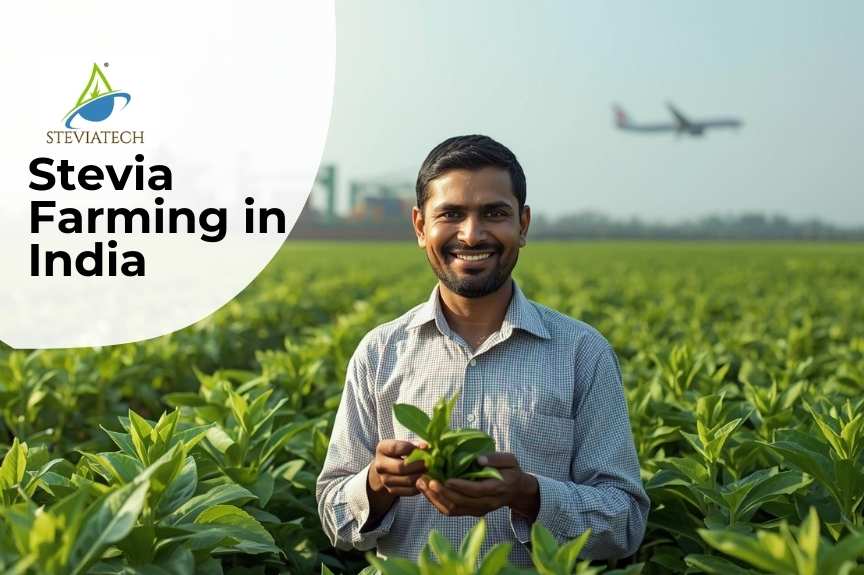
At the heart of sustainable Stevia cultivation in India is Steviatech’s contract farming program, designed for smallholder farmers in regions like Vijapur, Gujarat. Starting with soil testing and customized planting schedules, Steviatech provides disease-resistant varieties adapted to Indian monsoons, achieving 20-25% higher productivity than traditional methods. Farmers receive free training on drip irrigation, organic pest control using neem-based solutions, and foliar nutrition to boost stevioside content up to 12-15%.
Buy-back guarantees ensure stable income—Steviatech commits to purchasing entire harvests at fixed prices, shielding farmers from price volatility in the Stevia market India. This risk-free approach has onboarded over 500 acres, yielding consistent supplies for INSTEVIA® and NEXSTEVIA™ extracts, which feature de-bittered profiles for clean taste in teas and protein bars. By integrating digital monitoring via apps for real-time crop health, Steviatech reduces losses by 15%, exemplifying modern Stevia farming techniques.
Agronomy R&D: Boosting Productivity for Higher Yields
Steviatech invests heavily in Stevia agronomy R&D, developing proprietary hybrids with enhanced Reb M ratios for superior sweetness without aftertaste. Research focuses on bio-fertilizers like vermicompost and mycorrhizae, increasing leaf biomass by 30% while cutting chemical inputs by 50%—key to organic Stevia farming India. Trials in Gujarat demonstrate that intercropping Stevia with legumes improves soil fertility, enabling multi-year harvests from the same plot.
Propagation via stem cuttings, rather than seeds, shortens cycles to 90 days for first harvest, with plants productive for 5-7 years. Steviatech’s R&D also tackles challenges like leaf curl virus through resistant strains and precision agriculture, using drones for nutrient mapping. These innovations align with global trends toward next-generation Stevia, where high-purity extracts meet EU and US clean-label demands. For Indian farmers, this means higher Stevia yields per acre, from 2 tons to over 3.5 tons, fueling export growth.
Navigating India’s Stevia Market Growth and Health Trends
The India Stevia market surges due to health trends: with diabetes affecting 100 million Indians, demand for zero-calorie sweeteners in foods and pharma skyrockets. FSSAI approvals for Stevia glycosides in 2024-2025 have unlocked formulations in soft drinks and confectionery, projecting market value at $150 million by 2030. Steviatech capitalizes via vertically integrated operations—from farm to extract—ensuring traceability for clean-label Stevia sweeteners.
Consumer shift to natural products amplifies this: 70% of urban Indians prefer Stevia over aspartame, per recent surveys, boosting B2B sales for bakery and beverage giants. Steviatech’s water-soluble extracts support this, offering 1:1 sugar replacement without fermentation aftertaste. Sustainable practices like rainwater harvesting further enhance appeal, positioning Indian Stevia as premium in global chains.
Export Strategies for Global Clean-Label Demand
Amid a global Stevia market eyeing $876 million by 2034, India’s export potential shines through Steviatech’s strategies. Focusing on high-purity Reb D/M blends (95%+), the company targets EU, US, and Middle East markets via certifications like Kosher, Halal, and Organic USDA. Export-oriented farming emphasizes low-moisture drying to preserve glycosides, enabling shelf-stable powders for international clients.
Steviatech’s Gujarat hub streamlines logistics with cold-chain partnerships, reducing transit losses to under 2%. By 2026, exports aim for 40% of production, leveraging FTAs with ASEAN and EU for duty-free access. Blogs like this highlight Stevia export from India, attracting B2B inquiries for custom extracts in sports nutrition and pharma. Challenges like glycoside standardization are met with HPLC-tested batches, ensuring compliance.
Challenges and Future of Sustainable Stevia Farming
Despite growth, Stevia farming challenges India include initial setup costs and awareness gaps. Steviatech mitigates via subsidies and demos, proving ROI within 18 months. Climate resilience through shade nets and mulching counters erratic rains, vital as India faces warming trends.
Looking ahead, biotech like gene-edited Stevia promises 50% more sweetness, but Steviatech prioritizes non-GMO for natural appeal. Partnerships with ICAR expand Stevia cultivation areas to Rajasthan and Maharashtra, targeting 10,000 acres by 2030.
Sustainable Stevia farming in India via Steviatech’s model delivers profitability, eco-friendliness, and global reach. From contract farming to R&D-driven yields, it’s reshaping the natural Stevia sweetener landscape. Contact Steviatech at www.steviatech.com to start your risk-free journey in Stevia production India—secure seeds, guaranteed buys, and export-ready extracts await.