The cheapest sweetener on your purchase order may be the most expensive ingredient on your label.
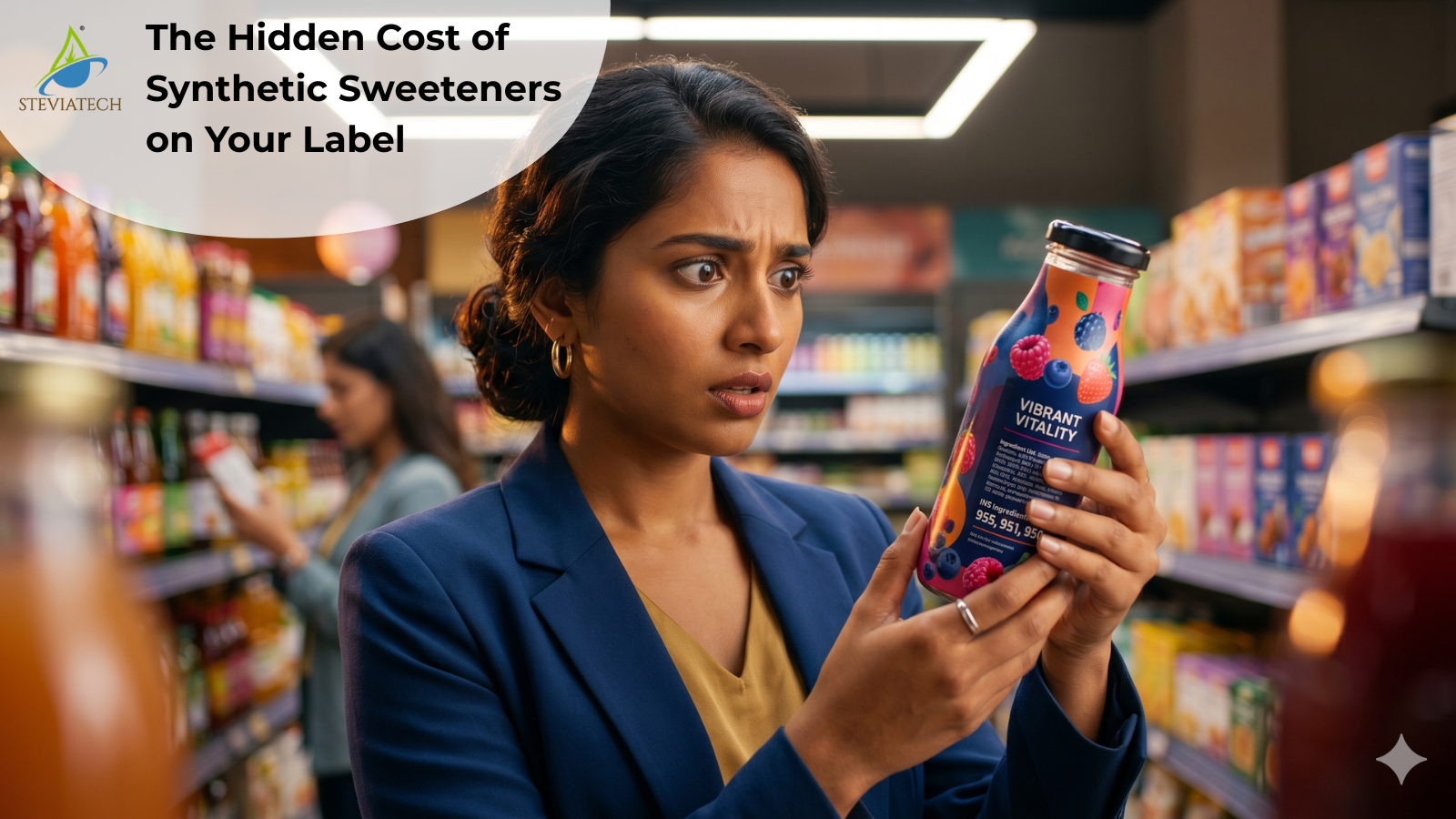
If your team evaluates sweetener systems on cost-per-kilogram and regulatory compliance, those inputs are correct. They are also incomplete. The cost that does not appear on the purchase order — the one that shows up in lost shelf placements, export friction, retailer audit scores, and future reformulation pressure — is carried by three codes: INS 955, INS 951, and INS 950.
This is not a “natural versus synthetic” argument. That framing has been done to death and it rarely changes a procurement decision. This is a commercial argument — about where the real cost of carrying these codes is accumulating, why it is accelerating, and what it means for brands that have not yet modelled it.
The metric that matters versus the metric that is measured
Procurement teams at Indian F&B companies evaluate sweeteners the way they evaluate most ingredients: cost-per-unit-of-sweetness, supply reliability, compliance documentation, and process compatibility. On all four metrics, synthetic sweeteners — particularly Sucralose (INS 955) — score well. At roughly 600 times the sweetness of sucrose, the dosage economics are favourable. Supply chains are mature. Drop-in formulation is simple.
None of these metrics are wrong. But none of them capture what happens after the ingredient enters the product and the product enters the market.
The cost that procurement is structurally underweighting is the cumulative commercial liability of carrying synthetic sweetener INS codes on a label that faces increasing scrutiny — from consumers, from retailers, from export-market gatekeepers, and from the brand’s own marketing team.
This cost does not appear on a purchase order. It surfaces in different departments, at different times, in forms that are harder to quantify but no less real.
INS 955 — Sucralose: the default that is becoming a question
Sucralose is the synthetic sweetener that Indian formulators reach for first. Heat-stable, clean initial sweetness, easy to blend — it dominates sugar-free and reduced-sugar variants across carbonated beverages, flavoured milk, tabletop sweeteners, protein supplements, and increasingly, bakery.
The formulation case for Sucralose is strong. The commercial case is developing cracks.
Consumer label perception is the first crack. INS 955 is not yet a mass-market red flag in India the way Aspartame has become in some Western markets. But among the urban 25–45 demographic — the segment that drives premium and health-positioned purchases — label scrutiny is accelerating. Ingredient-scanning apps are growing. Social media nutrition commentary is more specific than it was even two years ago. The shift is directional, not yet dominant, but the trajectory matters more than the current state.
Retailer and quick-commerce dynamics are the second. Large-format Indian retailers are beginning to develop internal product-scoring criteria that factor in ingredient profiles — though these frameworks are not yet publicly codified the way EU retailer clean-label scorecards are. Quick-commerce platforms use algorithmic ranking influenced by consumer ratings and returns. Products that attract label-related backlash may see indirect deprioritisation. The mechanism is real but early-stage in India — it would be dishonest to overstate it, but it would be negligent to ignore it.
Export friction is where the cost becomes concrete. EU regulations require specific labelling for Sucralose-containing products, and some EU retailers actively deprioritise synthetic-sweetener products in private-label procurement. GCC markets are tightening labelling requirements. For Indian F&B companies that export, carrying INS 955 creates a practical choice: maintain dual formulations for domestic and export SKUs, or reformulate to a single standard that satisfies the tightest market. Both options cost money. Neither cost appears on the sweetener purchase order.
Several Indian and multinational brands are already reformulating specific SKUs away from Sucralose — visible on shelf through label changes, though rarely announced publicly. The direction of movement is away from INS 955, not toward it.
INS 951 — Aspartame: the code that changed the conversation
Aspartame’s commercial trajectory illustrates how perception and regulation can diverge — and which one moves the market faster.
In July 2023, the International Agency for Research on Cancer (IARC) classified Aspartame as “possibly carcinogenic to humans” (Group 2B). Simultaneously, JECFA reaffirmed its existing acceptable daily intake of 40 mg/kg body weight per day. The regulatory conclusion: Aspartame remains safe at current usage levels. The consumer conclusion: something very different.
FSSAI has not altered Aspartame’s permitted status. But consumer trust in every product carrying INS 951 eroded faster than any regulatory body moved. For brands still carrying Aspartame in legacy diet CSDs, tabletop sachets, or pharmaceutical formulations, the ingredient is legally compliant — and increasingly a marketing liability.
Add the structural limitations: Aspartame degrades above approximately 86°C, eliminating it from baked goods, UHT-processed dairy, and retort applications. The mandatory “Contains phenylalanine” warning adds another negative label cue. For Indian exporters, INS 951 now faces the highest export friction of the three synthetic sweeteners — some European retailers have begun deprioritising Aspartame-containing products in private-label lines post-IARC.
The honest acknowledgement: Aspartame still delivers the most sugar-like sweetness profile of any synthetic sweetener, backed by the largest body of toxicological safety data of any food additive — over 200 studies reviewed by JECFA. Its supply chain is mature and cost-competitive. These are not trivial advantages. But they are advantages that exist in tension with an accelerating perception problem, and perception is what drives the purchase decision at shelf.
INS 950 — Acesulfame-K: the quiet code with a compounding problem
Acesulfame-K is the sweetener most Indian consumers cannot name. Low awareness has been its commercial advantage — less scrutiny than Aspartame, less consumer recognition than Sucralose.
That invisibility is eroding. Ingredient-scanning platforms, nutrition influencers, and clean-label advocacy are beginning to surface INS 950 as a synthetic additive consumers did not know they were consuming. The “quiet” code is getting louder.
But the more structural issue with Acesulfame-K is not the code itself — it is the blending dependency. Ace-K has a pronounced bitter-metallic aftertaste at typical use levels, which means it is almost never used alone. It appears alongside Sucralose or Aspartame as a sweetness-onset enhancer. The functional benefit is real: Ace-K genuinely improves the perceived sweetness curve in carbonated systems where rapid onset matters.
The label consequence is also real. A product carrying Ace-K carries at least two synthetic sweetener INS codes — INS 950 plus INS 955 or INS 951. Every additional code compounds the clean-label liability. The blending that makes Ace-K work functionally is the same blending that multiplies the label problem.
One additional dimension: some Acesulfame-K manufacturing processes use methylene chloride as a processing solvent. Residual levels are regulated and typically below detectable thresholds in the finished ingredient. This is a perception issue, not a safety issue at regulated levels — but clean-label scrutiny does not always distinguish between the two.
The honest counter-case: where synthetic sweeteners still win
A blog that only presents one side of a trade-off is not useful to the people making the decision. Synthetic sweeteners retain genuine advantages that stevia-based systems have not yet fully matched in every application.
Cost-per-unit-of-sweetness still favours synthetic sweeteners in most formulations. Stevia-based systems at equivalent sweetness levels cost more. This is the single largest barrier to switching, and pretending otherwise would undermine everything else in this argument.
Process simplicity is the second advantage. Sucralose drops into existing formulations with minimal modification. Stevia-based reformulation — particularly in dairy and bakery — often requires co-ingredients for mouthfeel, bulking, or flavour balance. That adds formulation complexity, development time, and cost.
Taste neutrality in complex matrices is the third. In bitter nutraceutical formulations, pharmaceutical syrups, and certain confectionery systems, Sucralose’s clean sweetness profile requires less masking work than stevia in some applications.
Blending synergy is the fourth. Ace-K’s rapid sweetness onset in carbonated beverages creates a first-sip perception that stevia-only systems have not fully replicated.
These are real. They belong in the decision. But they are inputs into a cost-benefit analysis — not the entire analysis.
The trajectory that matters more than today’s approval status
The question procurement and quality teams should be modelling is not whether FSSAI will restrict synthetic sweeteners tomorrow. The more commercially relevant question is what happens when three forces converge — and none of them require a regulatory change.
Consumer label literacy in urban India is becoming more specific, more ingredient-code-aware, and more influential on purchase decisions in premium and health-positioned categories. This pressure moves quarterly, not annually.
Retailer and platform gatekeeping is directionally moving toward ingredient-profile scoring — in export markets today, in Indian modern trade and quick-commerce tomorrow. Brands that are already clean-label-ready avoid a scramble later.
Export-market requirements are tightening. For brands that serve both domestic and international markets, carrying an INS code that faces scrutiny in the destination market creates a forced choice between dual formulation and single-standard reformulation. Both have costs. One has them now; the other has them later, under pressure, with less time.
The brands that reformulate proactively choose their timeline, their formulation partner, and their cost structure. The brands that wait inherit someone else’s timeline — driven by a retailer mandate, a consumer backlash, or an export rejection.
The cost-per-kg comparison is the right starting point. It is not the right ending point.
What the next decision looks like
The argument above is cross-category by design. The commercial pressure of synthetic sweetener INS codes applies whether your product is a carbonated beverage, a flavoured yoghurt, a protein supplement, or a tabletop sweetener.
But reformulation is never cross-category. It is specific. What works in a beverage system fails in a dairy matrix. What stabilises in ambient storage behaves differently in frozen. The gap between deciding to move away from a synthetic sweetener and knowing how to do it — in a specific product, at a specific price point, at production scale — is where most reformulation timelines stall.
That gap is worth examining closely. Starting with the category where the formulation challenge is most misunderstood.
Steviatech Life Pvt. Ltd. — Ahmedabad, Gujarat