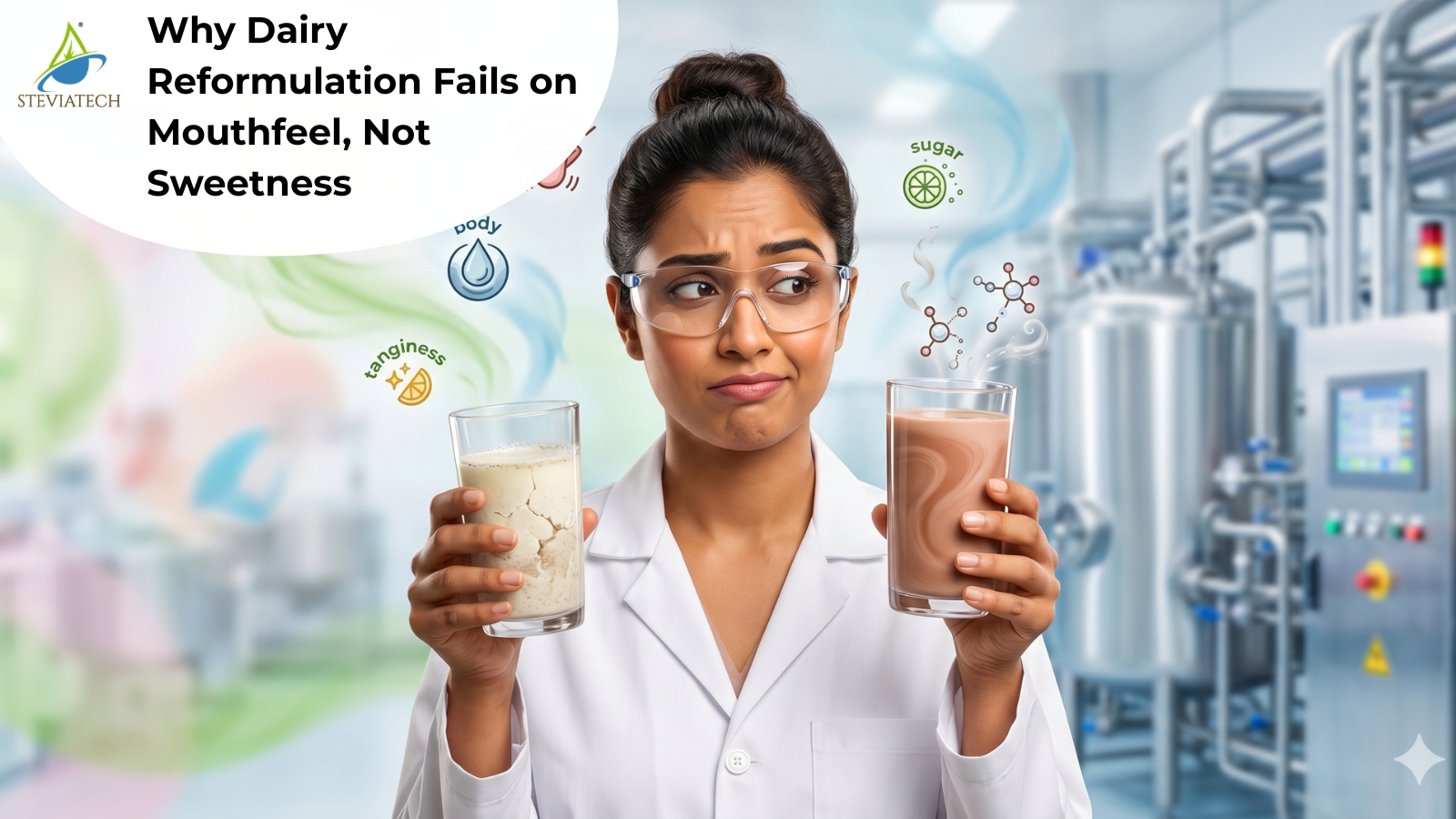
Most dairy reformulation pilots fail on mouthfeel, not sweetness.
The R&D team matches sweetness in week one. By week three, the product feels thin, watery, and subtly wrong in ways that are difficult to pin down in a sensory brief. The consumer panel does not say “the body is gone.” They say “it tastes different.” And then they stop buying.
This is the pattern in flavoured milk, in drinking yoghurt, in shrikhand. The sweetness is technically correct. The product is experientially wrong. The team blames stevia. But stevia was answering the only question it was asked: deliver sweetness at a target level. The problem is that sugar was answering four or five questions simultaneously, and the reformulation brief only addressed one.
Sugar’s four other jobs in dairy
Sweetness is the function every reformulation brief names. It is usually the least difficult to replace. The functions that break the product are the ones the brief does not mention.
Mouthfeel and body. Sugar at 8–12% in flavoured milk, 12–15% in drinking yoghurt, and 40–50% in shrikhand contributes viscosity, weight on the palate, and the perception of richness. Remove it and the product feels thin. This is the single most consumer-detectable failure in dairy reformulation, and the one most often missed in the brief because it is not a sweetness variable.
Flavour-compound interaction. Sugar modulates how flavour compounds release and how the palate sequences them. In chocolate flavoured milk, sugar suppresses cocoa’s polyphenol bitterness and rounds the overall profile. In strawberry, it balances the acidity of strawberry flavouring. Remove sugar and these interactions destabilise. The product does not just taste less sweet, it tastes differently wrong. The bitterness that surfaces in a chocolate variant reformulated with stevia is often blamed on the stevia. In most cases, it is a cocoa-polyphenol interaction that depends on which steviol glycoside is used. Stevioside and Reb A amplify this bitterness. Reb M and Reb D show significantly less amplification. The failure is glycoside-profile-specific, not stevia-generic.
Texture and structure. In set and stirred yoghurt, sugar competes with casein for water binding. This affects gel firmness and controls syneresis, the visible whey separation that appears on the surface when the consumer opens the pack. A “sugar-free” yoghurt with whey pooled on top is a quality failure before anyone tastes it. In shrikhand, sugar at 40–50% by weight is not a sweetener. It is half the product, contributing the dense, spoonable texture that defines the format.
Preservation. Sugar reduces water activity (Aw), extending shelf life. In high-sugar dairy formats (condensed milk, shrikhand, packaged dairy desserts), sugar IS the preservation system. Remove it without replacing the water-activity function and you create a microbiological risk that no sensory improvement can offset.
A reformulation brief that says “replace sugar with stevia” is asking for sweetness replacement. It is silent on the other four functions. That silence is where the pilot fails.
Where exactly it breaks: a sub-category walk
The failure mode varies by dairy format because sugar’s functional contribution varies by format.
Flavoured milk is the highest-volume opportunity and the most common site of first-attempt failure. The primary failure is mouthfeel loss: the product feels watery at the same sweetness level because sugar’s viscosity contribution has been removed without compensation. The secondary failure, in chocolate variants specifically, is bitterness amplification from the stevia and cocoa polyphenol interaction described above. Teams that use a standard Reb A extract encounter this reliably. Teams that use a glycoside profile weighted toward Reb M or Reb D encounter it far less. The difference is not stevia versus no stevia. It is which stevia, in which matrix, at which use level.
Drinking yoghurt and dahi-based drinks present a sweetness-acid sequencing problem. Yoghurt sits at pH 4.0–4.6. Sugar’s sweetness curve in acidic dairy is slow, rounded, and blended with the sourness. Stevia’s faster onset creates a “sweet then sour” sequence rather than the balanced “sweet-sour” perception consumers expect. The fix is not more stevia or less stevia. It is a sweetness system that manages onset timing in the specific acid-fat matrix of the product.
Set and stirred yoghurt adds a structural variable. Sugar’s water-binding role means its removal releases free water into the gel matrix. The consumer sees whey on the surface, an instant rejection trigger that has nothing to do with taste. A reformulation that solves sweetness but introduces syneresis has failed before the first spoonful. Hydrocolloid adjustment, water-binding agents, or reformulation of the base culture protocol are all part of the system solution.
Shrikhand is the honest stress-test. At 40–50% sugar by weight, removing sugar does not remove a sweetener. It removes half the product mass. No high-intensity sweetener at 0.02–0.05% use level replaces that. The solution requires a system: bulking agents for mass, mouthfeel enhancers for texture, hydrocolloid adjustment for structure, and a sweetener that works with all three. This is where “add stevia” most visibly fails and “design a sweetening system” most clearly succeeds. A 30–40% sugar reduction with a designed system is technically credible. Full replacement at parity is not yet commercially realistic without significant product redesign.
Lassi and buttermilk are the technically simpler case. Sugar’s role is predominantly sweetness with some acid balance. Stevia substitution at appropriate use levels is straightforward. The residual risk: aftertaste detection is higher in thin, low-fat matrices where there is less dairy fat to mask lingering notes. Glycoside profile selection matters even in the easy case.
Dairy desserts (packaged ras malai, basundi, payasam) need to be named honestly. Sugar in these formats is the soaking medium, the viscosity builder, and the preservation system. Removing sugar here is not reformulation; it is product redesign. A serious formulation partner names this boundary rather than overclaiming parity. Partial sugar reduction is credible. Full replacement at equivalent sensory and shelf-life quality requires a level of system redesign that goes well beyond a sweetener swap.
Where sugar and Sucralose still win, and why that matters
Sugar remains the best single dairy ingredient. Nothing else simultaneously delivers sweetness, body, flavour modulation, texture, and preservation. A blog that does not say this is not useful to the person making the decision.
Sucralose (INS 955) works for sweetness-only replacement in dairy when mouthfeel is maintained by other means, whether through fat content, stabiliser adjustment, or process modification. The trade-off, as the commercial case against INS codes makes clear, is the label liability that travels with the product into retail, export, and increasingly, consumer perception.
Partial sugar reduction, targeting 25–30% rather than full replacement, is technically simpler and commercially pragmatic. Many dairy R&D teams begin here. This is not a compromise; it is often the right first step, particularly in high-sugar formats like shrikhand and dairy desserts where full replacement at sensory parity requires system-level redesign that extends timelines and cost.
Polyols like erythritol and maltitol play a legitimate role in dairy dessert reformulation where stevia alone cannot provide the necessary bulk. A complete sweetening system sometimes includes them.
The difference between an ingredient and a system
The pattern across every failed dairy pilot is the same: the brief asked for an ingredient swap, and the reformulation needed a system. Sweetness is one variable. Mouthfeel, onset-decay timing, acid balance, texture stability, and flavour interaction are the others. A stevia extract, any stevia extract, addresses the first variable. The rest require a designed system that matches the specific dairy matrix.
This is the logic behind Sweet-n-Healthy™. It is not a stevia extract positioned for dairy. It is a ready-to-use sweetening system designed for dairy applications, addressing sweetness, mouthfeel compensation, and texture behaviour in a single formulation step. The glycoside profile is selected for dairy fat matrices. The system is built so that an R&D team’s first pilot is closer to production-ready than their third attempt with a standalone extract and an improvised co-ingredient stack.
The practical difference: fewer formulation cycles, less bench time spent solving mouthfeel and body problems that the sweetening system should have anticipated, and a cleaner label, with no INS 955, no INS 950, no synthetic sweetener codes.
In shrikhand and high-sugar dairy formats, Sweet-n-Healthy™ operates as part of a broader system that includes bulking and texture components. In flavoured milk and drinking yoghurt, it is closer to a direct-use solution. The application logic varies by sub-category, which is exactly why a designed system outperforms a generic ingredient in this category.
Same diagnostic, different physics
Dairy reformulation fails when the brief underestimates what sugar does beyond sweetening. The fix is not a better sweetener. It is a better question: what system replaces the full functional contribution of sugar in this specific format?
That question applies to every category where sugar is structural. In dairy, the dominant variables are mouthfeel, body, and acid interaction. In the next category worth examining closely, sugar’s structural role is entirely different: browning, volume, moisture retention, and crumb architecture. The diagnostic logic is the same. The physics are not.
Steviatech Life Pvt. Ltd., Ahmedabad, Gujarat