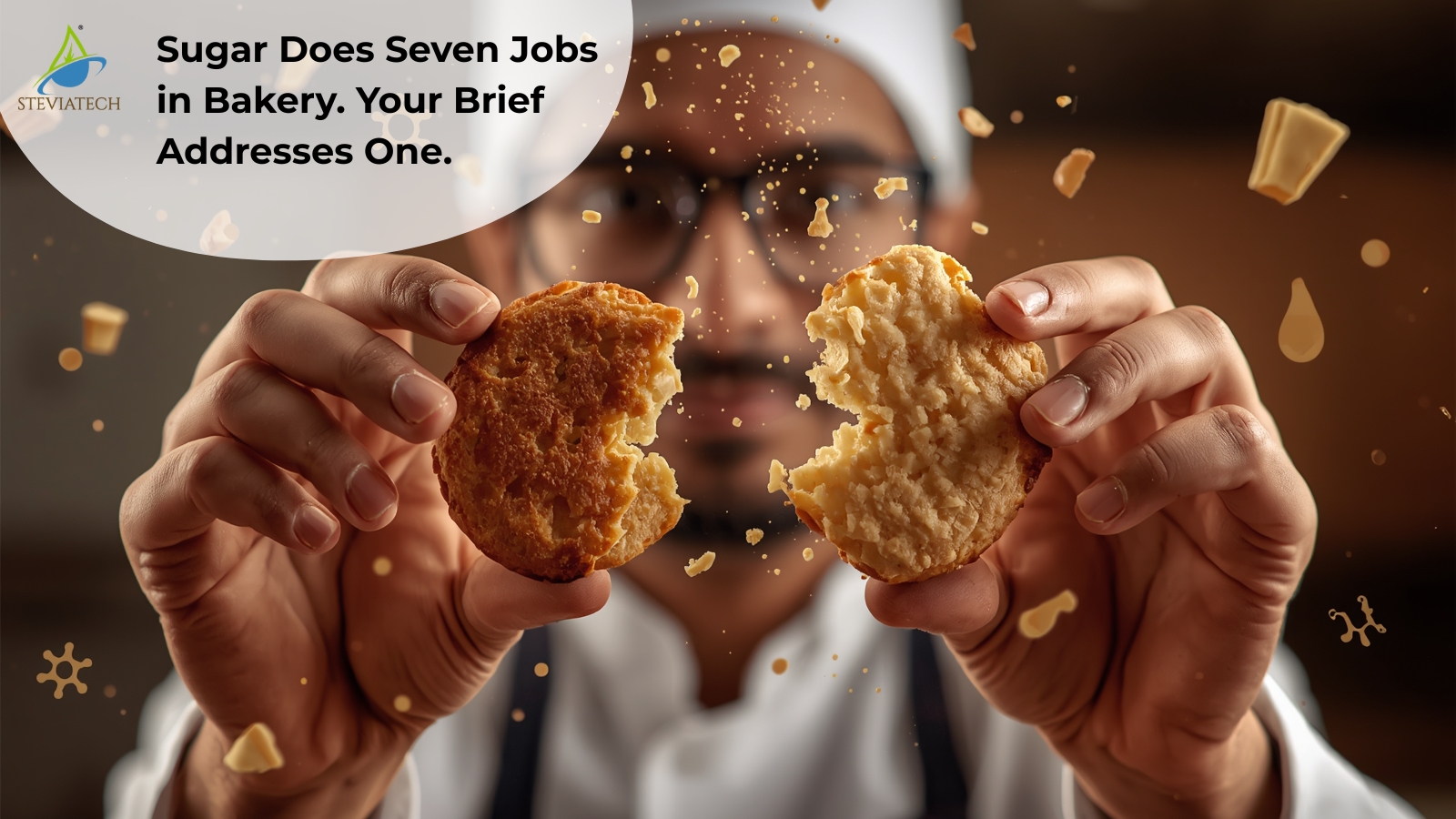
Sugar in a biscuit is doing seven jobs. Your reformulation brief is probably addressing one.
That gap, between what the brief asks for and what the formulation actually loses, is where most bakery sugar-reduction pilots fail. Not because the sweetener was wrong. Because the brief was incomplete.
In dairy reformulation, sugar’s hidden contributions are mouthfeel, body, acid balance, and preservation: four functions beyond sweetness. In bakery, the number is seven. Browning, bulk, moisture retention, texture, fermentation, crystallisation, and shelf life all depend on sugar. Remove it and you are not reformulating a recipe. You are redesigning a product, whether the brief acknowledges it or not.
Seven functions, one ingredient, zero replacements that do all seven
1. Sweetness is the function every brief names, and the easiest to replace. A high-intensity sweetener at a fraction of sugar’s weight matches perceived sweetness. This is why briefs say “just swap with stevia.” Everything below is why that instruction fails.
2. Maillard browning gives biscuits their golden colour, baked aroma, and characteristic flavour. The reaction requires reducing sugars, amino acids, and heat. No high-intensity sweetener is a reducing sugar. Remove sugar and the biscuit exits the oven pale, flat-smelling, and visually wrong before anyone tastes it. Replacing browning requires a separate intervention: a small amount of retained glucose or fructose specifically for Maillard contribution, malt extracts, or caramelised sugar additions. Stevia does not and cannot participate in this reaction. Any blog or brief that implies otherwise is misleading.
3. Moisture binding is sugar’s hygroscopic function. In cakes and muffins, sugar holds water in the crumb structure, keeping the product soft over days and weeks. Remove sugar and moisture migrates or evaporates faster. The sugar-reduced cake that passes the bench-top test on Day 1 is dry and crumbly by Day 5. Packaged cake shelf-life expectations in Indian modern trade are 15–30 days. Moisture loss across that window is one of the least visible but most commercially damaging reformulation failures. It shows up as consumer complaints and retailer returns, not in laboratory evaluation.
4. Bulk and structure. Sugar constitutes 30–60% of dry weight in biscuits and cookies, 20–40% in cakes. Removing it creates a mass deficit that sweetness alone cannot fill, since a high-intensity sweetener at 0.02–0.05% use level contributes zero bulk. The structural gap must be closed with bulking agents: polydextrose, soluble fibres like inulin or FOS, maltodextrin, or polyols such as erythritol. Each introduces its own processing, texture, and taste characteristics. Each is another raw material for procurement to source, quality to certify, and production to handle.
5. Yeast fermentation substrate. In bread, sugar feeds yeast during fermentation, producing the CO₂ that drives rise and the ethanol compounds that contribute to flavour. Remove sugar entirely and fermentation slows or stalls. Bread does not rise. The practical answer: retain a minimum of 1–3% fermentable sugar by flour weight for yeast activity and replace the remainder. Bread reformulation is always partial reduction. Zero sugar is not viable in any yeast-leavened product.
6. Crystallisation-driven texture. In biscuits, sugar’s re-crystallisation during cooling creates the clean “snap” when bitten, the precise fracture that distinguishes a Marie biscuit from a crumbly cookie. Replace sugar with non-crystallising sweeteners or bulking agents and the texture shifts: softer, denser, or crumblier than the original. Consumers expect specific textures from specific biscuit types. Texture deviation drives rejection even when sweetness is matched.
7. Shelf life via water-activity reduction. Sugar lowers water activity (Aw), inhibiting microbial growth. Industrial biscuits target Aw below 0.6; cakes below 0.85. Sugar is part of the preservation system. Remove it without replacing the Aw function (through alternative humectants, modified atmosphere packaging, or additional preservatives) and shelf life shortens. That is a direct commercial and food-safety problem, not a taste problem.
A brief that says “replace sugar with stevia” is asking one ingredient to do the work of seven. The reformulation does not fail because stevia is the wrong answer. It fails because it was given the wrong question.
Where exactly it breaks: category by category
Industrial biscuits and cookies are the hardest case because all seven functions fail simultaneously. The reformulated biscuit comes out pale (lost browning), with altered snap or excessive crumble (lost crystallisation texture), drier over shelf life (lost moisture binding), and lighter in mass (lost bulk). Sweetness may be correct. Everything else is wrong. The “sugar-free” biscuits currently on Indian shelves that use Sucralose (INS 955) solve sweetness and survive baking heat, but do nothing for the other six functions. The product carries the INS code AND delivers an inferior eating experience. This is the worst of both approaches.
Cream-filled and sandwich biscuits compound the problem. The shell carries all standard biscuit challenges. The filling, typically 60–70% sugar blended with fat and flavouring, uses sugar as its structural backbone. Without sugar, the filling loses body, becomes oily, and may not set to the right consistency. Erythritol-based fillings can partially replicate the crystalline texture but introduce a cooling sensation and change the taste profile. The challenge is dual: reformulate the shell and reformulate the filling, each with different functional gaps.
Cakes and muffins expose the moisture-binding failure most clearly. The sugar-reduced cake that is soft on Day 1 pulls complaints by Day 5 as moisture migrates out of the crumb faster than the full-sugar version. The bench-top test did not predict the shelf failure. Sugar also plays a role in the creaming step: beating sugar with fat incorporates air for rise. Removing sugar without adjusting aeration changes crumb density.
Bread and rusk are constrained by yeast biology. Sugar feeds fermentation. The practical ceiling is partial reduction: retaining enough fermentable sugar for yeast activity while replacing the balance with a non-fermentable sweetening system. Rusk, being twice-baked, depends more heavily on sugar for browning and crispness. Full sugar elimination in any yeast-leavened product is not technically viable.
Nankhatai is the cultural stress-test, much as shrikhand was for dairy. The characteristic sandy, melt-in-mouth texture comes from the interaction between sugar crystals and ghee during mixing, where sugar’s granularity and crystalline behaviour are structural, not just sweetening. Remove sugar from nankhatai and you do not get a sugar-free nankhatai. You get a different product. Reformulation here is redesigning a cultural format, and it demands a system that addresses texture, bulk, and sweetness as a single integrated solution. Partial sugar reduction at 30–40% is technically credible. Full elimination changes the product’s identity.
Where sugar and synthetic sweeteners still have the advantage
Sugar remains the only single ingredient that simultaneously delivers sweetness, browning, bulk, moisture retention, texture, fermentation support, and shelf-life control in bakery. No alternative replicates all seven. A credible reformulation strategy acknowledges this and works within it.
Sucralose (INS 955) survives baking temperatures and delivers sweetness in heat-processed applications. For sweetness-only replacement, it works. The trade-off is the INS code on the label, and the fact that it addresses one of seven functional roles.
Erythritol and other polyols play a legitimate role for bulk replacement, particularly in biscuit fillings and cookie doughs where mass is needed. The trade-offs (cooling sensation, potential gastrointestinal sensitivity at higher dosages, and added ingredient cost) are manageable within a designed system.
Partial sugar reduction, targeting 25–35%, is more realistic than full elimination in most bakery formats. It is technically achievable with contained formulation adjustment. Full elimination requires multi-ingredient system redesign that extends timelines and may alter product identity. Thirty percent reduction with consumer acceptance is commercially stronger than full elimination with compromised quality.
What a bakery-ready system actually looks like
The pattern across failed bakery pilots is consistent: the brief asked for an ingredient swap, and the product needed a system. Every additional function that sugar performed and the replacement did not becomes another raw material to source, another variable to optimise, another process adjustment to validate. System complexity is the silent cost of incomplete briefs.
Sweet-n-Healthy™ in bakery is a different formulation from Sweet-n-Healthy™ in dairy: different blend ratios, different co-ingredient architecture, different use-level guidance. In dairy, the system addresses mouthfeel and body. In bakery, it addresses sweetness, contributes to bulking, and supports moisture retention in a single pre-formulated step, reducing the number of new ingredients an R&D team needs to source and qualify separately.
What it does not do is replace browning. No stevia-based system participates in Maillard. Browning requires either retained reducing sugars or a separate browning solution, and a formulation partner that names this honestly rather than overclaiming. Similarly, in yeast-leavened products, a minimum fermentable sugar level must be retained for dough rise regardless of the sweetening system used.
The practical value for a bakery production line: fewer new ingredients to handle, less process disruption, and a system designed for bakery matrices rather than adapted from a generic stevia data sheet. An R&D team working against a product-launch timeline needs a starting point that is closer to production-ready than a standalone extract and a list of co-ingredients to figure out independently.
Same question, harder chemistry
Dairy reformulation fails when the brief underestimates mouthfeel. Bakery reformulation fails when the brief underestimates structure. In both cases, the diagnostic is the same: understand what sugar actually does in the specific matrix before writing the replacement brief.
There is one category where this diagnostic gets harder still. Where sweetness interacts with carbonation, where onset timing is measured in fractions of a second, and where the first sip defines whether the product succeeds or fails. The chemistry there is different from anything in dairy or bakery, and the formulation challenge is the most technically demanding of all.
Steviatech Life Pvt. Ltd., Ahmedabad, Gujarat