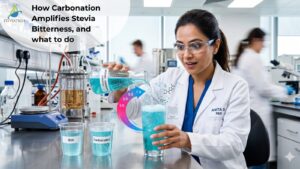
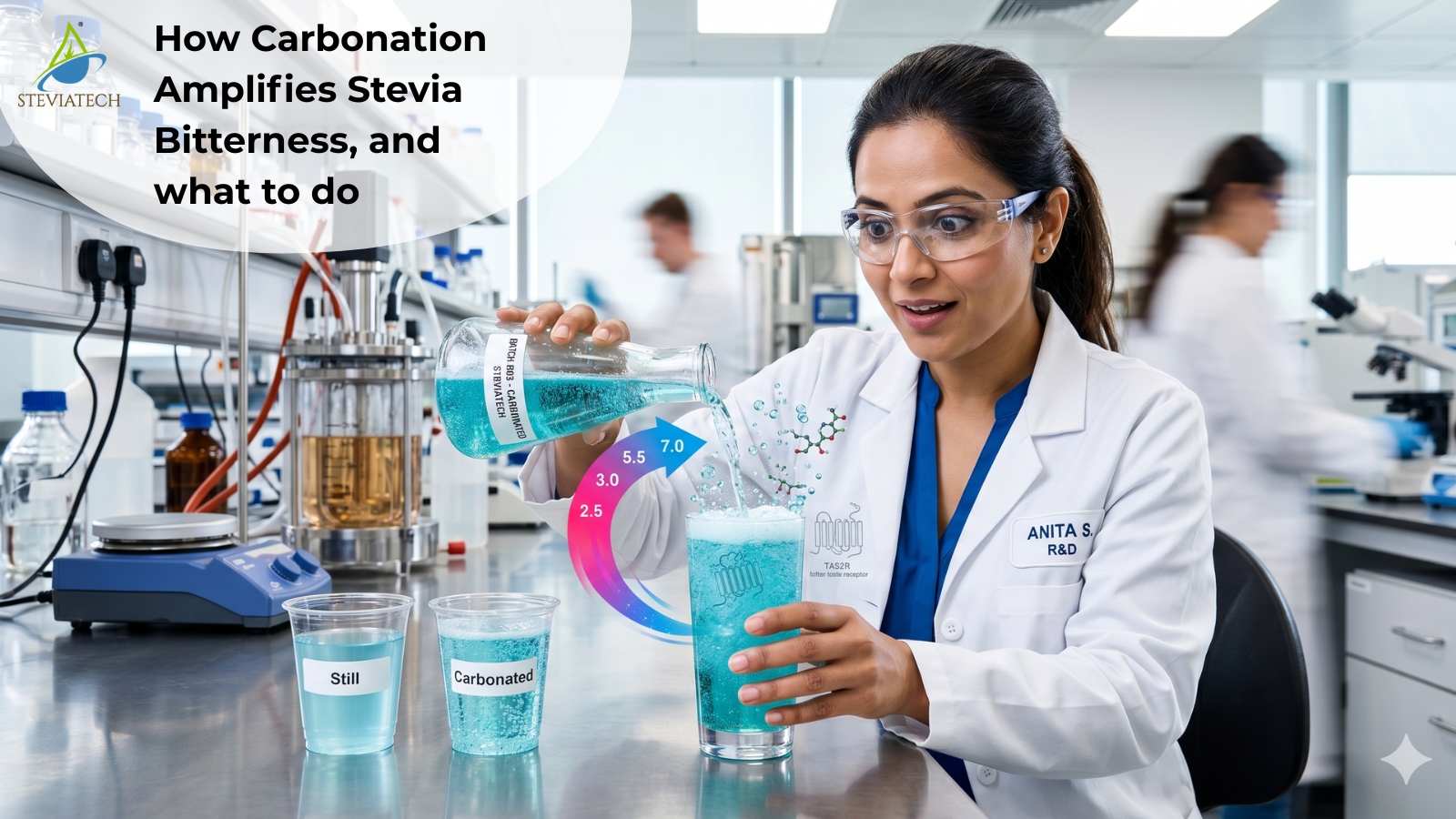
Most beverage teams discover the carbonation-bitterness interaction in round three of prototyping. By then the brief is committed, the timeline is compressed, and the stevia extract that tasted clean in flat water tastes bitter at 3.8 volumes of CO₂. The extract did not change. The chemistry of perception did.
This is the most common failure sequence in stevia-sweetened carbonated beverage development: formulation developed and approved in still water, bench-top tasting passes, pilot batch gets carbonated and bitterness appears that was not there before. The project stalls. Sometimes the team reformulates. Sometimes they revert to synthetic sweeteners and accept the label compromise.
The failure is real. But it is not a stevia problem. It is a glycoside-selection problem one that becomes visible only under the specific chemistry of carbonation. Understanding that chemistry changes the formulation approach entirely.
Three steps from CO₂ to bitterness
The interaction chain has three steps, and each one matters for the formulator.
Step one: CO₂ dissolution. Carbon dioxide dissolves in water under pressure to form carbonic acid (H₂CO₃). The degree of carbonation typically expressed as volumes of CO₂ determines how much carbonic acid forms. A standard CSD at 3.5–4.0 volumes generates significant carbonic acid load.
Step two: pH reduction. Carbonic acid lowers pH. A typical cola already sits at pH 2.5–2.8 from phosphoric acid; citrus CSDs at pH 3.0–3.2 from citric acid. Carbonation pushes effective pH even lower during consumption as CO₂ releases in the mouth. The beverage the consumer tastes is more acidic than the pH meter reads in a degassed sample.
Step three: bitter-receptor activation. Bitter taste perception is mediated by TAS2R receptors a family of approximately 25 G-protein-coupled receptors on the tongue. Certain steviol glycosides, particularly Stevioside and Reb A, are known to activate TAS2R4 and TAS2R14 at use-relevant concentrations. At lower pH, the protonation state of these glycoside molecules changes, which appears to alter their binding affinity to TAS2R receptors. The net effect: increased bitter perception under acidic carbonated conditions, particularly for extracts dominated by Stevioside and Reb A.
The bitterness was always latent in the glycoside profile. Carbonation did not create it. Carbonation surfaced it.
97% purity is not the spec that matters
Here is the technical paradox most commodity stevia suppliers do not disclose.
The stevia extract market has standardised around Reb A purity as the primary quality metric. A 97% Reb A extract commands a higher price and is positioned as a premium product. But Reb A is among the glycosides with the strongest known TAS2R activation. The extraction and purification processes that produce high-purity Reb A are selecting for the compound most likely to generate bitterness under carbonation.
Purity percentage does not predict carbonation performance. Glycoside profile does.
Not all steviol glycosides trigger bitterness equally. Stevioside and Reb A the most abundant in the raw leaf and the cheapest to produce at scale carry the highest bitterness risk, amplified under low-pH carbonated conditions. Reb M and Reb D, higher-order glycosides with more glucose moieties attached to the steviol backbone, show a significantly cleaner taste profile under the same conditions. The structural hypothesis, supported by sensory data though not fully elucidated mechanistically, is that the larger molecular structure of these higher-order glycosides sterically hinders fitting into the TAS2R binding pocket, reducing bitter signalling. Their different protonation behaviour at low pH may also maintain a conformation less favourable for receptor activation.
The practical implication for the formulator: an extract enriched for Reb M and Reb D, with reduced Stevioside and Reb A fractions, starts with lower bitterness potential. Lower baseline means less to amplify when carbonation drops the pH. The carbonation performance difference between a commodity 97% Reb A extract and a glycoside-profile-optimised extract is not incremental. It is the difference between a pilot that fails on bitterness and one that does not.
The extraction process that creates the problem
Conventional stevia extraction uses ethanol or methanol-based solvent systems. These are efficient at isolating high-purity Reb A which, as established, is the glycoside with the strongest bitter-receptor activation profile. The conventional process selects for the problem compound. This is not a manufacturing defect. It is a structural misalignment between what the extraction optimises for (Reb A purity) and what carbonated-beverage performance requires (low TAS2R activation under acidic conditions).
NEXSTEVIA™ is built on a different extraction logic. Steviatech’s alcohol-free, water-based purification and de-bittering process reduces the concentration of bitterness-associated glycoside fractions Stevioside and dominant Reb A and enriches for cleaner-tasting glycoside profiles. The de-bittering step is not cosmetic. It is the mechanism that produces a taste profile with significantly reduced bitterness potential before carbonation enters the equation.
The distinction matters for the beverage formulator in a specific way: when requesting a stevia extract for a carbonated application, the relevant specification is not Reb A purity percentage. It is glycoside profile distribution, bitterness-receptor activation data at target pH, and sensory performance data under carbonation at the intended CO₂ volume. A supplier that provides only a purity spec and a generic data sheet is selling a commodity. The formulator working on a carbonated product needs more.
Where synthetic sweeteners still have the cleaner path in carbonation
The standard diet CSD sweetener system globally and in India is an Aspartame (INS 951) and Acesulfame-K (INS 950) blend. It works. Ace-K provides rapid sweetness onset that registers on the first sip. Aspartame provides body and the closest sweetness profile to sucrose of any high-intensity sweetener. Neither generates bitterness under carbonation. The blend has decades of consumer acceptance data and is proven at scale in every major cola and lemon-lime formulation on the Indian market.
In raw taste performance in carbonated systems, this blend remains the simplest, cheapest, and most proven. A blog that does not say this is not useful to the person evaluating the switch.
Sucralose (INS 955) also performs cleanly in carbonated applications no bitterness amplification, heat-stable, straightforward to formulate with. Some consumers report a metallic or chemical note, but this is less prevalent than stevia bitterness in carbonated systems.
What these sweeteners cannot do is deliver a clean label. The Aspartame–Ace-K blend carries two synthetic sweetener INS codes INS 951 and INS 950. Sucralose carries INS 955. The commercial cost of those codes consumer scrutiny, retailer scoring, export friction, perception risk was the subject of the first blog in this series. The chemistry of removing them is the subject of this one.
The argument is architectural, not just sensory
NEXSTEVIA™ does not need to outperform the Aspartame–Ace-K blend on taste alone to earn its place in a carbonated formulation. The value proposition is architectural: competitive taste performance under carbonation closer to sugar-like sweetness, with a significantly cleaner taste profile than commodity stevia extracts combined with a clean label carrying no synthetic sweetener INS codes, no mandatory warnings, and no export-market friction.
For beverage R&D teams evaluating the reformulation path: the question is not whether NEXSTEVIA™ tastes identical to the Aspartame–Ace-K system. It does not, and claiming otherwise would be dishonest. The question is whether the combination of carbonation-viable taste performance plus label improvement plus regulatory future-proofing justifies the switch. For brands in the premium, health-positioned, functional, or export-facing segments the answer is increasingly yes.
From label economics to formulation chemistry
This series began with a commercial argument: the cost of carrying INS 955, INS 951, and INS 950 on a product label extends well beyond the purchase order. It moved into the specific formulation science of dairy and bakery what sugar actually does in each matrix, why the reformulation brief matters more than the ingredient choice, and what a designed sweetening system looks like versus a simple ingredient swap.
This final piece addresses the hardest technical question in the set: how to remove synthetic sweeteners from carbonated beverages without reintroducing the bitterness problem that stopped most previous attempts. The answer is not better stevia. It is the right stevia the right glycoside profile, produced by the right process, specified for the right application.
The formulation challenge in every category is different. The diagnostic logic is the same: understand what the current ingredient actually does, understand what breaks when you remove it, and design the replacement as a system, not a swap.
That is the difference between a supplier that sells you an extract and a formulation partner that helps you solve the problem.
Steviatech Life Pvt. Ltd. Ahmedabad, Gujarat